## Chapter 1: The Day my Mother left
Some memories don’t fade; they just lose their sharp edges until something rough scrapes against them again. For me, that edge is the smell of burnt toast and cheap floral perfume.
I was eleven years old wmotherhen the world as I knew it shattered. It was a Tuesday. I remember because Tuesday was soccer practice, and my mom was supposed to pick me up. She never showed. When my dad finally arrived, his face was the color of skim milk. He didn’t say a word on the drive home, his knuckles white against them steering wheel.
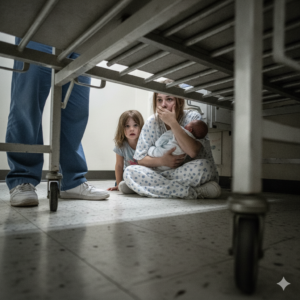
When we walked through the front door, the house was eerily quiet. Her closet was empty. The jewelry box on her dresser was gone, leaving behind a clean square of dust on the dark wood. There was no grand cinematic argument, no tears, no dramatic exit. Just a note on the kitchen counter that read: *“I need to find myself. I’m sorry. Please don’t hate me.”*
She had left us for a man named Julian—a contractor who had repaired our roof six months prior.
From that day forward, it was just me and Dad.
My dad didn’t sit around and feel sorry for himself. He swallowed his pride, took on a second job at the logistics depot, and poured every ounce of his remaining energy into raising me. He taught me how to shave, how to drive, and how to spot a fake friend from a mile away. Three years after she left, using every penny of his savings and a hefty loan, he bought the charming, slightly weathered colonial house on Elm Street.
“This is our fortress, Leo,” he told me, wiping sweat from his brow as we carried the first couch into the livingmother room. “No one can take this from us.”
That house became our sanctuary. It was where I grew up, where I studied for college, and where—eventually—my dad breathed his last breath after a brave battle with cancer. When he passed, he left the house to me. It wasn’t just brick and mortar; it was a monument to a father’s fierce, unwavering love.
## Chapter 2: The Voice from the Dead
I am twenty-eight now. I work from home as a freelance architectural designer, spending my days surrounded by blueprints, 3D renderings, and the quiet comfort of the Elm Street house.
Last week, on a rainy Thursday afternoon, my phone rang. It was an unknown number with a local area code. Thinking it was a client or a delivery driver, I picked it up.
“Hello, Leo speaking.”
There was a long pause on the other end. All I could hear was a faint, raspy wheeze, followed by a shaky intake of breath.
“Leo? Is that… is that really you?”
The voice was older, thinner, and utterly stripped of its vitality, but the cadence was unmistakable. It sent a sudden, violent jolt of adrenaline straight to my heart. It was a voice I hadn’t heard in seventeen years.
“Who is this?” I asked, though my stomach already knew the answer.
“It’s your mother, Leo. It’s Eleanor.”
I sat down heavily in my office chair. The room seemed to tilt. “What do you want?” My voice was cold, flat, and devoid of the warmth I usually extend even to strangers.
“I know I have no right to call you,” she sobbed, a fragile, broken sound that might have moved me if I hadn’t spent a decade watching my father bleed out his youth to pay for her absence. “But I don’t have much time left. The doctors… it’s stage four pancreatic cancer, Leo. It’s spread everywhere. I only have a few weeks, maybe a couple of months.”
I closed my eyes. I expected to feel a wave of grief, or perhaps a surge of vindictive joy. Instead, I felt a profound, heavy numbness. “I’m sorry to hear that,” I said politely, as if she were a distant acquaintance telling me about a bad day at work.
“Julian is gone,” she whispered. “He left when the medical bills started piling up. I’m all alone, Leo. I’m so scared.”
“Why are you calling me, Eleanor?” I used her first name intentionally. I hadn’t called anyone “Mom” since I was eleven years old.
She took a ragged breath, clearing her throat before delivering the request that made my blood run cold.
> “It’d mean a lot if I could stay in the home I raised you in. I want to spend my final days in a place that felt like family. Please, Leo. Let me come home to die.”
## Chapter 3: The Sanctuary Stays Sealed
I stared at the wall, where a framed photograph of my dad and me at my college graduation hung. He was smiling so wide his eyes were squinted shut, his arm slung proudly around my shoulder.
*The home she raised me in?*
The audacity of her words felt like a physical slap. She hadn’t raised me in this house. She had abandoned me before we ever even saw this house. She had left us in a cramped, rented apartment. My dad bought this place *because* she left. This house was built on the ashes of her betrayal. She had no memories here. She had no history here.
“No,” I said quietly.
“Leo, please—”
“No,” I repeated, my voice hardening into granite. “You don’t get to do that. You don’t get to rewrite history because you’re running out of time. You didn’t raise me in this house. My dad did. He built this life for us while you were out living yours with someone else.”
“I made a mistake, a horrible mistake!” she wept openly now. “I’ve regretted it every single day. Please, don’t let me die alone in a sterile hospital room. I just want to be near my son.”
“You chose to leave your son seventeen years ago,” I said, tears of old anger finally stinging my eyes. “You don’t get to claim him now just because it’s convenient for your conscience. Do not call this number again.”
I hung up the phone before she could reply. My hands were shaking so badly I dropped the device onto the desk.
For the next few days, I lived in a fog of guilt and rage. Had I been too harsh? She was dying, after all. But every time I looked around the beautiful, quiet house, I remembered my dad’s tired eyes, his calloused hands, and his absolute devotion. Letting her step foot in this sanctuary felt like a betrayal of his memory. I had made my choice, and I was going to stand by it.
Then came yesterday.
## Chapter 4: The Knock on the Door
It was just past 4:00 PM yesterday when the sharp, authoritative knock echoed through the front hallway.
I wasn’t expecting anyone. I walked to the door, opened it, and found myself face-to-face with two police officers. A veteran sergeant with grey hair and a younger officer who looked ill at ease.
“Leo Vance?” the older officer asked.
“Yes, that’s me. Can I help you, officers?”
The sergeant sighed, adjusting his utility belt. He looked at me with a mixture of professional detachment and profound pity.
“Mr. Vance, we’re here regarding your mother, Eleanor Vance.”
My chest tightened. A heavy dread pooled in my gut. Had she passed away? Had she succumbed to the illness sooner than expected?
“What happened?” I asked, bracing myself for the news.
The sergeant took off his hat, holding it against his chest. “Mr. Vance, your mother was brought into the county hospital early this morning. But before she lost consciousness, she handed the attending medical staff a sealed manila envelope addressed specifically to you, with strict instructions to involve local authorities if she didn’t make it through the night.”
He reached into his jacket and pulled out a thick, legal-sized envelope.
“She passed away at 3:14 AM,” the sergeant said softly. “But what the detectives found inside this envelope… Mr. Vance, we need you to come down to the station immediately. There is something about your childhood, and about your father, that you need to see.”
## Chapter 5: The Weight of a Dead Woman’s Secrets
The drive to the precinct was a blur of flashing brake lights and the rhythmic, hypnotic slap of my windshield wipers. The words of the police sergeant echoed in my mind over and over again like a broken record: *Something about your childhood, and about your father, that you need to see.*
My father? Arthur Vance? He was a saint. He was the man who worked twelve-hour shifts at the logistics depot, whose boots were always caked in mud or dust, and whose hands were permanently rough from manual labor. He was the man who sat by my bedside when I had the flu, cooking terrible, watery chicken soup but staying up all night just to make sure my fever broke.
What could my mother—a woman who ran away with another man and left her eleven-year-old child behind—possibly have to say about him?
When we arrived at the station, I was led into a quiet, windowless interview room. It smelled faintly of stale coffee and industrial cleaning solution. A detective named Miller, a tired-looking woman with her hair pulled back into a tight bun, was waiting for me. On the metal table between us sat the thick, manila envelope.
“Sit down, Leo,” Detective Miller said, her voice surprisingly gentle. “I know this is a lot to take in, especially right after learning of your mother’s passing. I’m sorry for your loss.”
“I haven’t lost her,” I said, my voice hollow. “I lost her seventeen years ago. Right now, I just want to know what this is.” I pointed at the envelope.
Detective Miller sighed, sliding the envelope across the table toward me. “Your mother arrived at the ER in critical condition. Organs failing, barely conscious. But she clung to this envelope like her life depended on it. She told the nurse that if she died, it had to go to you through the police, because she feared if it went through regular mail, it might get intercepted or ignored. Go ahead. Open it.”
My fingers trembled as I broke the plastic seal the police had used to log it into evidence. I reached inside and pulled out a thick stack of papers.
My eyes skipped past the official documents and landed on the letter, written in a shaky, frail cursive script. I began to read.
## Chapter 6: The Letter from the Grave
> *My dearest Leo,*
> *If you are reading this, it means my time has run out, and you have finally received the truth that I was too terrified to tell you while I was alive. I know you hate me. I know you look back on the day I left as the moment I abandoned you. For seventeen years, I have let you believe that lie, because believing I was a monster was the only thing keeping you safe.*
> *Leo, I didn’t leave you because of another man. I never loved Julian. Julian wasn’t a lover—he was a security guard at a domestic violence shelter.*
> *Your father, Arthur, was not the man you thought he was…*
> I stopped reading. My heart hammered violently against my ribs. “This is a lie,” I whispered, slamming the paper down on the table. “This is a sick, vindictive lie from a woman who wanted to hurt him even from the grave! My dad never laid a hand on me. He loved me!”
“Keep reading, Leo,” Detective Miller said quietly, her eyes fixed on me. “Look at the medical records underneath.”
With a racing heart and blurred vision, I forced myself to look at the next document. It was a medical intake form from Saint Jude’s Hospital, dated October 14th, 2008—the year before she disappeared.
*Patient: Eleanor Vance. Injury: Fractured orbital bone, three broken ribs, severe contusions to the abdomen.*
*Patient statement: Fell down the basement stairs.*
*Physician note: Injuries highly inconsistent with a fall. Signs of severe physical trauma, likely domestic abuse.*
There were three more records just like it, stretching over a two-year period.
I choked back a sob, my mind fiercely rejecting the images forcing their way into my head. My dad? The man who spoke softly, who tucked me into bed?
“No,” I argued, my voice cracking. “Even if… even if they had a toxic marriage, why did she leave *me*? If she was fleeing him, why didn’t she take her eleven-year-old son? Why did she abandon me to live with a monster?”
“Turn to page three of the letter,” Detective Miller instructed.
## Chapter 7: The Impossible Choice
I picked up the shaky cursive pages again, my tears blurring the ink.
> *The night I left, your father found out I had gone to a lawyer to file for divorce and full custody of you. He came home in a rage I had never seen before. He choked me until I blacked out on the kitchen floor. When I woke up, he was standing over me holding a hunting knife.*
> *He told me that if I ever tried to take you, or if I ever called the police to have him arrested, he would kill you first, then me, and then himself. He looked into my eyes, Leo, and I knew he meant it. He was a deeply sick, controlling man who viewed you not just as a son, but as his ultimate possession.*
> *He gave me an ultimatum. I could leave that night, by myself, with nothing but the clothes on my back, and never look back. If I did, he promised he would give you a perfect life. He would never hurt you, he would protect you, and he would raise you well. But if I tried to take you with me, or if I stayed and fought him, he said he would ensure neither of us lived to see another day.*
*I was terrified, Leo. I was broken, bleeding, and utterly powerless. Julian, who worked at the shelter I had secretly visited, agreed to drive me across state lines that very night just to keep me alive. I sacrificed my relationship with you, allowed you to hate me, and let your father paint me as the villain, because it was the only currency I had to buy your safety.*
*The note left on the counter? Your father forced me to write it at knifepoint before he let me walk out the door.*
I dropped the pages. The room completely ran out of oxygen. The walls of my beautifully designed life, built entirely on the memory of a heroic, self-sacrificing single father, began to crumble into dust.
Everything I thought I knew was a beautifully orchestrated illusion.
## Chapter 8: The Price of Silence
“We cross-referenced these documents with old archives,” Detective Miller explained, breaking the heavy silence. “In 2009, your mother did try to go to the authorities in a different state. She filed for a restraining order, which is included in that packet. But your father found out. Look at the last set of documents.”
I pulled out the bank ledger. It showed a series of massive, monthly withdrawals from my father’s account starting the exact month we moved into the Elm Street house. Every single month, $1,500 was wired to an anonymous account.
“Blackmail,” I whispered, the pieces finally clicking together in a horrifying puzzle.
“Extortion,” Detective Miller corrected. “Your father was paying Julian and your mother to stay away. He threatened that if the payments stopped, or if she ever tried to contact you, he would follow through on his original threat. Your mother lived in absolute poverty in a tiny studio apartment three towns over, dying of cancer, while your father used his ‘hard-earned money’ to buy a beautiful house on Elm Street to keep you compliance-bound to him.”
The sergeant walked back into the room, holding a small cardboard box. “Mr. Vance, as the next of kin, your mother’s personal effects from the hospital have been released to you. There wasn’t much. Just her clothes, a cheap flip phone, and this.”
He placed a small, worn, velvet jewelry box on the table.
With trembling hands, I opened it. Inside was a tiny, tarnished silver charm bracelet. Hanging from the chain was a single charm: a miniature soccer ball.
It was the birthday present she was supposed to give me on that fateful Tuesday seventeen years ago. She had kept it with her every single day of her exile.
I collapsed onto the metal table, clutching the tiny silver bracelet to my chest, and wept for the mother I had hated, the father I had idolized, and the profound lie that had built my entire existence.
But the nightmare wasn’t over.
“Mr. Vance,” Detective Miller said, her voice dropping to an urgent whisper. “There’s one more thing. Your mother’s phone. We looked at her call logs from the night before she died. She didn’t just call you. Someone else called her. Someone using your father’s old landline number from the Elm Street house.”
My breath caught in my throat. “That’s impossible. My dad has been dead for two years. The landline was disconnected.”
“We checked with the service provider,” Detective Miller said, her face grim. “The line was re-activated three weeks ago. And someone is inside your house right now.”
## Chapter 9: The Drive into the Dark
The drive back to Elm Street felt entirely different from the journey to the police station. The pouring rain no longer just blurred the windshield; it felt like a heavy, suffocating weight pressing down on the roof of my car.
My mind was a chaotic storm of conflicting realities.
* **The Lie:** A loving, noble single father who sacrificed his youth to build a safe haven for his abandoned son.
* **The Reality:** A calculating, abusive tyrant who isolated his child, coerced a mother at knifepoint, and paid blood money for seventeen years to maintain his absolute control.
“Who is in that house?” I whispered to myself, my knuckles locking around the steering wheel.
Detective Miller had offered to send a squad car with me, but a sudden, desperate urge for answers made me wave her off. I told her I would check it out myself first—a lie, of course, just to ensure I didn’t have flashing red and blue lights alerting whoever was inside. The police promised to loop back and station a cruiser down the block within twenty minutes.
But twenty minutes felt like a lifetime.
When I pulled into the gravel driveway of the colonial house, it looked completely dead. The dark green shutters were closed tight against the storm. The porch light, which I always left on, was dead. The entire structure looked less like a sanctuary and more like a tomb.
I sat in the idling car for a long moment, clutching the small velvet jewelry box containing my mother’s silver soccer-ball charm.
*She wanted to die here,* I realized with a painful twist in my gut. She didn’t want the house because it was beautiful; she wanted to reclaim the space that had been stolen from her. She wanted to reclaim *me*. And I had told her no.
## Chapter 10: Shadows on the Wall
I stepped out of the car, letting the freezing rain soak through my jacket. I walked up the porch steps, the wood creaking softly under my boots—a sound that used to bring me comfort but now sent shivers down my spine.
I unlocked the heavy oak front door, pushing it open.
The house smelled faintly of old paper, damp wood, and something else… a metallic, sharp scent that didn’t belong. I stepped into the foyer and reached for the light switch. I flipped it.
Nothing happened. The power was out.
Using the flashlight on my phone, I cut a thin beam of white light through the darkness of the living room. Everything looked exactly as I had left it. My architectural blueprints were rolled up on the coffee table. The framed photo of my dad and me at graduation still hung on the wall.
I walked up to the photograph. Looking at his smiling face now, the expression seemed entirely different. The proud crinkles around his eyes looked like malicious amusement. The arm slung around my shoulder didn’t feel like a protective embrace anymore—it felt like a cage.
I turned away, sickened, and walked toward the small alcove off the kitchen where the old landline telephone wiring used to sit.
There, sitting on the dusty wooden counter, was a vintage, cream-colored rotary phone. It hadn’t been there when I went to sleep the night before. I hadn’t owned a landline phone in a decade.
Beside the phone lay a small, handwritten note on a scrap of yellow legal paper. The handwriting was neat, precise, and instantly recognizable. It was my father’s script.
> *“A house is only a fortress if you control who holds the key, Leo.”*
>My breath hitched. My father was dead. I had watched him take his last breath in a hospice bed. I had signed the cremation papers. I had buried his ashes in the cemetery three miles away.
Suddenly, a loud, heavy *thud* echoed from directly beneath my feet.
## Chapter 11: The Secret Floorboards
The sound came from the basement.
My father had always kept the basement locked. He told me the structural foundations were weak, that old mold lived down there that would trigger my childhood asthma, and that it was strictly used for storing his old industrial tools from the logistics depot. I had never questioned it. He kept the heavy brass padlock on the door, and the key hung on his personal keyring, which had been buried with his effects.
I walked slowly toward the basement door at the end of the kitchen hallway.
The heavy brass padlock was gone. It lay open on the linoleum floor, reflecting the beam of my phone’s flashlight. The door itself was slightly ajar, a sliver of pitch-black darkness yawning from the other side.
“Is someone down there?” I called out, my voice trembling.
No answer. Only the sound of the rain drumming violently against the kitchen window.
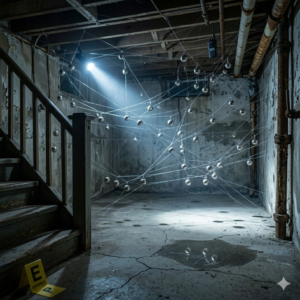
I pushed the door open. The stairs groaned as I stepped onto the first riser. The air grew instantly colder, thick with the scent of damp earth and rust. As I descended, my flashlight beam swept across the concrete walls.
The basement wasn’t a storage unit for tools.
At the bottom of the stairs sat a small, neatly arranged living space. There was a twin-sized cot with fresh wool blankets, a small folding table with a battery-powered lantern, and a stack of notebooks.
I approached the table, my heart pounding in my throat. I picked up the top notebook and flipped it open.
The logs went back for two years. Every single day of my life since my father’s “death” had been recorded, cataloged, and watched from the very darkness beneath my feet.
## Chapter 12: The Guardian
“You always were too curious for your own good, Leo.”
I spun around, dropping my phone. The flashlight beam rolled across the concrete floor, illuminating a pair of worn leather work boots standing by the shadows of the water heater.
I looked up. Standing there, holding a heavy iron wrench, was a man who looked like an older, gaunt ghost of my father. But it wasn’t my father.
It was Julian.
The man my mother had allegedly run away with. The man who was supposed to be a security guard at a shelter. He looked frail, his hair entirely white, his eyes wide and unblinking in the dark.
“Julian?” I choked out, backing away until my spine hit the stone foundation wall. “What… what are you doing here? My mother is dead.”
“I know she’s dead,” Julian said, his voice a low, raspy gravel. “I watched the hospital from the parking lot. She broke the pact, Leo. She was never supposed to call you. She was never supposed to tell you what happened.”
“You helped my father,” I whispered, the horrifying truth crashing down on me. “The letter said you helped her escape, but you didn’t. You were working for him the whole time.”
Julian let out a dry, hacking laugh that echoed off the damp concrete. “Your father was a very wealthy man by the end, Leo. That logistics job? He wasn’t just moving pallets. He was moving things he shouldn’t have been. He paid me to pretend to be Eleanor’s savior. He wanted her to think she had an ally, someone to run away with, so she wouldn’t look suspicious to the neighbors when she disappeared.”
He took a step closer, raising the wrench.
“And when your father died, he left me a final directive in his will. A trust fund that only pays out if I keep ensuring you stay in this house, completely isolated, maintaining his legacy. I’ve been living down here, keeping the fortress secure. But now you know. And I can’t let you ruin the perfect life Arthur built for you.”
From the top of the basement stairs, the front door of the house violently burst open.
“Police! Hands in the air!”
## Chapter 13: Justice in the Dark
The basement erupted into chaotic motion. Heavy, tactical boots pounded down the wooden stairs, the sound echoing like thunder in the enclosed concrete space. Powerful beams of white light cut through the damp darkness, blinding me and catching Julian dead in their crosshairs.
“Police! Drop the weapon! Drop it now!” Detective Miller’s voice rang out, authoritative and unyielding.
Julian froze. For a terrifying second, his knuckles tightened around the heavy iron wrench, his wild, unblinking eyes darting between me and the stairs. He looked like an animal cornered in its own burrow. Then, with a hollow clang that vibrated through the floorboards, he let the tool fall to the concrete.
Two officers rushed forward, slamming Julian against the stone foundation wall and pulling his arms behind his back. The sharp *click* of handcuffs signaling the end of his two-year shadow reign felt like a sudden release of pressure in my chest. I collapsed against the wall, sliding down until my knees hit the cold floor, gasping for air that finally felt clear.
Detective Miller holstered her weapon and knelt beside me, placing a steadying hand on my shoulder. “You’re safe, Leo. We watched the house, saw the power grid fail, and knew something was wrong. It’s over.”
I looked over at Julian as he was led up the stairs. He didn’t look like a mastermind anymore. He looked like a pathetic, broken old man who had traded his humanity for a dead man’s blood money.
“The notebooks,” I whispered, pointing a trembling finger at the folding table. “He was watching me. My dad… my dad never let him go.”
“We’re seizing everything,” Miller promised gently. “Every notebook, every bank record, every scrap of evidence. Your father’s fortress is officially breached.”
## Chapter 14: The Inventory of Cruelty
It took three days for the police and forensic accountants to fully dismantle the life Arthur Vance had manufactured. Because I was the sole legal heir and the victim of an elaborate, lifelong psychological trap, Detective Miller kept me informed of every discovery.
The depth of my father’s deception was staggering.
The logistics depot hadn’t just been a place of honest blue-collar work. Behind the water heater in the basement, hidden inside a false concrete panel that Julian had been protecting, detectives found a safe. Inside were ledger books detailing an illicit smuggling ring my father had operated throughout the early 2000s. The money didn’t come from double shifts; it came from crime.
He had used that money to buy the Elm Street house, not as a gift for me, but as a golden cage. He had forced my mother out, paid off her supposed ‘savior’ to act as a double agent, and ensured she would live out her days in terror and poverty, too frightened to ever step forward. He had built a narrative where he was the saint and she was the sinner, and I had swallowed it whole for seventeen years.
Sitting in my empty living room, looking at the bare walls where our photographs used to hang, the weight of my own words crushed me.
*“You don’t get to rewrite history because you’re running out of time,”* I had told her on the phone.
But she wasn’t rewriting history. She was trying to survive it. She had begged to die in the home she raised me in. I finally understood what she meant. She didn’t mean the physical bricks of Elm Street. She meant *me*. I was the home she had built, the only piece of love she had left in the world, and I had barred the door against her.
## Chapter 15: A Son’s Late Goodbye
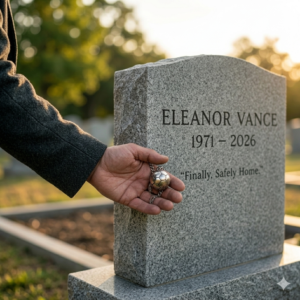
The funeral for Eleanor Vance was a quiet affair. There were no distant relatives, no old friends, and no grand floral arrangements. There was only me, Detective Miller, and a minister who spoke softly of peace, rest, and forgiveness.
I stood before the modest casket, holding the small velvet jewelry box in my hands. I opened it, pulling out the tarnished silver charm bracelet with the tiny soccer ball.
“I’m sorry,” I whispered, tears finally flowing freely down my face, washing away the years of manufactured resentment. “I’m so sorry I didn’t listen. I’m sorry I let him win for so long.”
I placed the bracelet gently inside the casket, resting it against her hands.
> “You bought my safety with your sorrow,” I said, my voice thick with emotion. “You let me hate you so I could live a peaceful life. That is the purest love a mother could ever give. I know the truth now, Mom. The fortress is gone.”
> When the service ended and the earth reclaimed her, I felt a profound shift within myself. The anger that had fueled my ambition, the rigid walls I had built around my heart to protect myself from ever being ‘abandoned’ again—they evaporated. I was no longer the victim of an abandoned childhood. I was the son of a hero.
## Chapter 16: New Foundations
I couldn’t live on Elm Street anymore. The air in that house was thick with the ghosts of tyranny and deceit. Every architectural line I had admired felt like a bar of a prison cell. But I didn’t want to just sell it to a random developer and walk away with blood money. I needed to sanitize the space. I needed to rewrite its purpose.
As an architectural designer, I realized I had the power to reshape reality through structural design.
I liquidated my father’s entire estate, including the illicit funds uncovered by the police, and channeled them into a permanent foundation. I drew up new blueprints—not for high-end clients or luxury estates, but for a sanctuary of a different kind.
A year later, the house on Elm Street was gone, completely demolished and rebuilt from the ground up. In its place stood a beautiful, sunlit, modern facility named **The Eleanor Vance Sanctuary**—a fully funded shelter and transitional housing unit for victims of domestic abuse and coercive control.
The dark, locked basement was replaced by an open-concept communal kitchen and a garden filled with vibrant, blooming flowers. The air no longer smelled of damp earth and rust; it smelled of fresh coffee, clean linens, and hope.
On the opening day, I stood in the main foyer, watching a young mother guide her small son through the doors. The boy was holding a soccer ball under his arm, his eyes wide as he looked around the bright, safe space. The mother looked tired, her shoulders tense, but as she looked at the welcoming rooms, her posture softened, and she let out a long, shuddering breath of relief.
I smiled, a genuine, deep-seated warmth spreading through my chest.
My father had built a fortress of isolation, but love had dismantled it. My mother never got to spend her final days in the safety of my arms, but through her sacrifice, hundreds of other mothers and children would find their way out of the dark.
I looked up at the brass plaque mounted near the entrance, bearing her name and a single engraved silver charm.
*We are finally home, Mom.*
**[The End]**
If yoy liked this story then read this one too: