The rain in Willow Creek didn’t just fall; it settled. It was the kind of persistent, bone-chilling drizzle that turned the gravel roads into slick ribbons of mud and forced the townsfolk to retreat behind heavy oak doors. For Clara Vance, the weather was a perfect match for her mood.
At thirty-two, Clara had returned to her childhood home not out of nostalgia, but out of necessity. Her grandmother, Evelyn, had passed away a month prior, leaving behind a sprawling, Victorian house packed to the rafters with history, dust, and secrets. Clara’s task was to sort through it all, a duty she had been avoiding until the legal notices left her no choice.
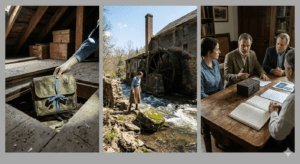
The attic was the heart of the house’s memory. Under the sloping eaves, cardboard boxes competed for space with moth-eaten armoires and stacks of forgotten paintings. Clara wiped her brow, leaving a streak of soot across her forehead. She was about to call it a day when her foot caught the edge of a loose floorboard.
It didn’t just creak; it gave way entirely.
With a sharp gasp, Clara dropped her flashlight. It rolled into the gap, its beam illuminating a narrow, hidden compartment between the joists. Kneeling on the cold timber, she reached into the darkness. Her fingers brushed against canvas.
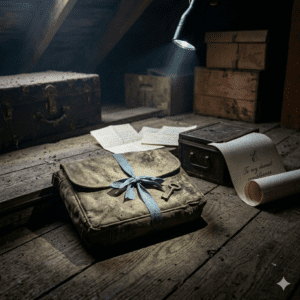
She pulled out an old, military-issue satchel. The leather was cracked and stiff, smelling intensely of mildew and ancient cedar. Inside, wrapped carefully in oiled silk to protect them from the damp, lay a bundle of letters. They were tied with a faded blue ribbon, the ink on the top envelope bleeding slightly, but the handwriting was unmistakably elegant.
“To my dearest compliance, where the truth must never tread.”
Clara frowned. The phrasing was bizarre, almost like a code. As she untied the ribbon, a small, tarnished brass key fell into her lap.
1. Uncovering Hidden Small-Town History in the Attic
The first letter was dated October 14, 1944. Clara sat cross-legged on the attic floor, the patter of rain against the roof providing a rhythmic backdrop to the scratchy script.
“My dearest compliance,” the letter began. “The ledger is safe. I have hidden the records where the shadow of the old mill meets the water at noon. If they find out what we did with the shipments from the valley, the entire town will burn. Do not trust the Sheriff. Do not trust your own shadow.”
It was signed simply, “E.”
Clara’s heart hammered against her ribs. Her grandmother’s name was Evelyn, but the handwriting didn’t match the gentle, shaky script Clara remembered from birthday cards. This was sharp, precise, and frantic.
She opened the second letter, then the third. The correspondence spanned over three years, detailing a massive, clandestine operation in Willow Creek during the height of World War II. It wasn’t about enemy spies or military tactics. It was about money, missing people, and a massive land grab that laid the foundation for the town’s current wealth.
The founding families of Willow Creek—names still plastered on street signs, parks, and the local bank—were implicated. According to the letters, they had systematically falsified records to seize the property of families who had left for the war or disappeared under mysterious circumstances.
Clara leaned back against a trunk, her mind racing. She had grown up respecting these names. The Blackwoods, the Archers, the Fields. They were the aristocracy of this small valley.
She looked at the brass key in her hand. The letters mentioned a ledger, a definitive record of the theft and the names of those who were wronged. But where was it? The old mill had been abandoned for decades, a hollow shell of brick and iron sitting on the edge of the rushing creek.
Tomorrow, she decided, she would visit the mill.
As she packed the letters back into the satchel, she couldn’t shake the feeling that she was being watched. The shadows in the corners of the attic seemed to stretch, lengthening as the storm outside intensified. She locked the attic door behind her, but the chill followed her all the way down to the kitchen.
2. The Mysterious Clues Hidden Inside Forgotten Letters
The next morning broke clear and crisp, the sun burning away the mist that clung to the valley floor. Clara walked down Main Street, the satchel heavy against her hip. She felt an undercurrent of paranoia she had never experienced here before.
Every greeting from a neighbor felt loaded. When Mayor Thomas Archer waved at her from the steps of the town hall, Clara’s stomach tightened. The Archers were mentioned prominently in the letters. It was Thomas’s grandfather who had signed the fraudulent deeds.
She bypassed the center of town and headed toward the creek. The path to the old mill was overgrown with briars and stinging nettles, nature’s way of reclaiming a place of industry. The mill itself was a haunting structure, its massive waterwheel frozen in mid-turn, choked by ivy.
Clara stepped through the broken doorway. The air inside was thick with the scent of damp earth and rotting wood. She pulled out the first letter, re-reading the clue: “where the shadow of the old mill meets the water at noon.”
She checked her watch. It was 11:45 AM.
She walked out to the edge of the crumbling stone foundation overhanging the creek. The water below was fast and dark, churning with spring runoff. She watched the sun climb to its zenith. Slowly, the massive shadow of the mill’s chimney lengthened across the water, pointing like a dark finger toward a specific spot in the stone foundation.
Clara scrambled down the slippery bank, her boots sinking into the mud. She reached the area indicated by the shadow. The stones here were covered in moss. She used a pocketknife to scrape away the green velvet, revealing a small, circular indentation in the mortar.
It was exactly the size of the brass key.
With trembling hands, she inserted the key and turned it. With a grinding crunch, a loose stone shifted outward. Behind it sat a rusted iron box.
“Looking for local history, Clara?”
The voice startled her so badly she nearly slipped into the river. She snapped her head around to see Arthur Pendelton, the town’s amateur historian and a lifelong friend of her grandmother, standing on the path above.
Arthur was in his late seventies, always wearing a tweed jacket despite the weather. But today, his usual warm smile was missing. His eyes were fixed intently on the iron box in her hands.
3. A Small Town Divided by Past Confrontations
Clara scrambled back up the bank, clutching the box to her chest. “Arthur. You scared me.”
“I apologize,” he said softly, stepping closer. “I saw you walking down this way. Not many people come to the mill anymore. It’s dangerous.”
“I was just exploring,” Clara lied, her voice tight. “Finding some old things of my grandmother’s.”
Arthur’s gaze drifted to the satchel on her hip. “Evelyn was a complicated woman, Clara. She kept things. Things that perhaps should have stayed buried for the peace of this town.”
The realization hit Clara like a physical blow. Arthur knew. He knew about the letters, and he knew what was in the box.
“What did they do, Arthur?” Clara demanded, abandoning the pretense. “The founding families. My grandmother. What is in this ledger?”
Arthur sighed, a sound heavy with decades of carrying a burden. He looked around the quiet woods, as if checking for eavesdroppers. “The war changed people, Clara. It made them desperate. And it made them greedy. When the families who built this valley didn’t come back, others decided their land shouldn’t go to waste. But it wasn’t just abandonment. Some were… encouraged to leave.”
“It was theft,” Clara whispered.
“It was survival, they told themselves,” Arthur corrected gently. “And now, those families’ descendants run the schools, the banks, the local government. If that box contains what I think it does, it will ruin lives. People who had nothing to do with the original sin will lose everything.”
“And what about the people who were robbed?” Clara countered, her anger flaring. “Don’t they deserve justice?”
Arthur didn’t answer immediately. He looked at the rushing water of the creek. “Justice is a beautiful concept, Clara. But in a small town, truth can be an arsonist. It burns down the good with the bad.”
He stepped back, gesturing toward the path. “Go home. Look at what’s inside. But think about the living before you avenge the dead.”
4. Deciphering the Truth Behind the Willow Creek Scandal
Back in the safety of her kitchen, Clara broke the lock on the iron box with a hammer. Inside was a thick, leather-bound ledger.
As she flipped through the yellowed pages, the full scale of the conspiracy became clear. Column after column detailed property values, forged signatures, and payoffs to local law enforcement. Her grandmother Evelyn had been the bookkeeper. She had tracked every cent, every acre, and every lie.
But Evelyn had also kept a diary section at the back of the book.
“I cannot carry this weight anymore,” the diary entry from 1952 read. “We built this town on a graveyard of broken promises. I keep these records not to protect the guilty, but to ensure that one day, when the hold of the old families weakens, someone can right these wrongs. The Archer estate belongs to the descendants of the Miller family. The Blackwood orchards belong to the fletchers.”
Clara sat in the quiet house for hours, the ledger spread out before her. She realized why her grandmother had been so reclusive in her later years. It wasn’t dementia or stubbornness; it was guilt. She had lived surrounded by the wealth built on her own silence.
The phone rang, shattering the quiet. It was Mayor Archer.
“Clara, evening,” Thomas Archer said, his tone jovial but beneath it lay a sharp edge. “Arthur mentioned he ran into you at the mill today. Said you found some old family documents. I’d love to take a look at them for the town archive. We’re doing a retrospective for the centennial next month.”
The implied threat was subtle, but it was there. They knew she had it.
“I’m still sorting through things, Thomas,” Clara said, keeping her voice steady. “I’ll let you know if I find anything of historical value.”
“Please do,” Archer said. “We wouldn’t want any… misunderstandings disrupting the peace of Willow Creek. See you around, Clara.”
She hung up, her hands shaking. She was alone in the house, holding a fuse that could blow the entire community apart. She could destroy the town’s elite, but it would also destroy the stability of the place she called home.
5. The Ultimate Resolution of Willow Creek’s Hidden Secrets
Clara didn’t sleep that night. She spent the hours scanning every page of the ledger with her phone, uploading the files to a secure cloud drive. If anything happened to the physical book, the truth would survive.
The next morning, she made three phone calls. She didn’t call the police, and she didn’t call the newspapers. Instead, she called the descendants of the families who had been wronged—those who still lived in the state, scraping by while others prospered on their ancestral lands.
She arranged a meeting at the old mill.
When she arrived, three people were waiting for her: Sarah Miller, a young defense attorney from the city; David Fletcher, a local mechanic; and Arthur Pendelton.
A few minutes later, a black sedan pulled up. Mayor Thomas Archer stepped out, looking worried. He had clearly been tipped off that something was happening at the mill.
“What is this, Clara?” Archer asked, looking at the small gathering.
Clara stepped forward, holding the ledger. “This is the truth, Thomas. This is the record of how your grandfather stole the land your house sits on. It’s the record of how the Blackwoods took the orchards.”
Archer’s face went pale, then hardened. “This is ancient history. No court will honor a seventy-year-old book of rumors.”
“It’s not rumors,” Sarah Miller stepped forward, her eyes fierce. “It’s a meticulously detailed record of fraud, backed up by original deeds Clara found in the archives. And as a lawyer, I can tell you that the statute of limitations on fraud doesn’t begin until the crime is discovered.”
David Fletcher stepped up next. “We don’t want to burn the town down, Mayor. But we want what’s ours. We want restitution.”
Archer looked from face to face, realizing he was completely cornered. The leverage was absolute. If this went public, the lawsuits would bankrupt his family, and the scandal would destroy his political career.
“What do you want?” Archer asked, his voice barely a whisper.
“A quiet transition,” Clara said firmly. “A trust fund established by the founding families to compensate the descendants. The return of undeveloped land to its rightful heirs. And a public acknowledgment in the town history of what actually happened. No names dragged through the mud today, but the truth must be recorded.”
Archer looked at the ledger, then at the river. He nodded slowly. “Agreed.”
Months later, Clara stood on the porch of her grandmother’s house. The air was warm, the summer sun shining brightly over Willow Creek. The town hadn’t burned down. Instead, it was slowly healing. The old mill was being restored, funded by the new trust, transforming it into a museum dedicated to the entire history of the valley—both the light and the dark.
Clara looked at the empty attic window. The weight was finally gone, not just from the house, but from the town itself. The echoes of Willow Creek were no longer whispers of guilt, but promises of a fairer future.
You may also like to read similar story:
👉 I Was Thrown Out of My Own Restaurant for Wearing a T-Shirt. By Midnight, the Entire Staff Quit.