Every Morning, I Secretly Fed a Quiet, Hungry Boy
The neon sign of the Highway 4 Diner didn’t so much glow as it buzzed, a low, irritable hum that matched the mood of my boss, Arthur. It was 5:30 AM. The world outside was a bruised purple, the mist hanging low over the asphalt like smoke.
I liked the quiet of the early shift. It gave me time to brew the first pot of coffee, wipe down the laminate counters, and breathe before the truckers and commuters arrived to demand their grease and caffeine.
Then, there was the boy.
He appeared on a Tuesday. He couldn’t have been more than nine or ten years old, wearing an oversized denim jacket that looked like it had survived three older brothers and a couple of dog fights. He sat on the low concrete barrier just beyond the reach of our outdoor lights. He wasn’t crying.
He wasn’t throwing rocks. He was just watching the diner window with a hollow, steady stare that twisted something deep in my stomach.
I knew that look. I’d seen it in my own reflection years ago, back when my mother was working three jobs and “dinner” was a glass of tap water and an early bedtime.
I looked back at the kitchen. Arthur was in the office, loudly arguing with a meat distributor over the price of bacon.
I grabbed a paper plate. I slid two fluffy buttermilk pancakes onto it, topped them with a generous pat of butter, and wrapped two strips of crispy bacon inside. I didn’t bother with a ticket. I just walked out the side door, the crisp morning air hitting my bare arms.
The boy didn’t move as I approached. Up close, I could see the smudge of dirt on his cheek and the way his knuckles were white from clutching his own elbows.
“Hey there,” I said, keeping my voice low and soft. “I made too much breakfast. Think you could help me out?”
He looked at the plate, then up at me. His eyes were incredibly dark, older than they had any right to be. He didn’t say a word, but his hand reached out, trembling slightly. He took the plate.
“My name’s Clara,” I added.
He didn’t answer. He just took a massive bite of the pancake, his shoulders dropping a fraction of an inch. I smiled, turned around, and walked back inside before Arthur could notice I was gone.
“You’re Wasting Food,” My Boss Said
By Friday, it had become a ritual. The boy—whom I secretly nicknamed “The Shadow” because he never made a sound—would appear at exactly 5:40 AM. And every morning, a plate of warm food would find its way out the side door.
I learned a few things about him without him ever speaking. He loved maple syrup. He always ate the bacon first. And he never, ever left a single crumb behind.
But a diner kitchen isn’t a place where secrets stay buried for long. Arthur kept inventory like a man convinced the world was trying to rob him blind. He could tell you down to the ounce how much flour we had left, and he noticed the missing strips of bacon.
On a rainy Thursday morning, I was wrapping up two scrambled eggs and toast when a heavy hand clapped down on my wrist.
I jumped, nearly dropping the paper plate. Arthur was standing over me, his face the color of old lard, his breath smelling heavily of stale cigars.
“You’re wasting food,” my boss said, his voice a low, gravelly rumble that vibrated through the small kitchen.
“Arthur, it’s just some eggs and toast,” I muttered, trying to pull my wrist away. “The boy outside, he’s starving. He’s just a kid.”
“I don’t run a charity, Clara,” Arthur snapped, releasing my arm but stepping closer, blocking the exit to the side door. “I run a business. Margins are razor-thin. You want to feed every stray mutt that wanders off the highway, you pay for it out of your tips. Otherwise, it goes in the trash where it belongs.”
“He’s not a mutt,” I said, a rare spark of anger flaring in my chest. “He’s a child.”
“He’s a distraction. And he’s bad for business,” Arthur countered, pointing a greasy finger at the window. “People see a kid begging outside, they think the neighborhood is going to hell. Next time I see you sneaking food out that door, you can follow it out. Permanently. Do I make myself clear?”
I looked past him, through the rain-streaked glass. The boy was sitting there, his hood pulled up, water dripping from the brim. He was shivering.
“Clear,” I whispered.
Arthur grunted, satisfied with his victory, and shuffled back to his office. I waited until I heard the click of his calculator. Then, I shoved the eggs into a container, slipped a five-dollar bill from my own pocket into the register to cover the cost, and ran out into the rain.
Then One Day, the Diner Was Surrounded by Black SUVs
Two weeks passed. Every day, I paid for the boy’s breakfast out of my own meager earnings. I didn’t care about the money. The look of quiet gratitude in his eyes when I handed him the warm container was worth more than any tip a truck driver could leave me.
He had started speaking a little. Not much, just a quiet “Thank you, Clara,” that sounded like it took an immense amount of effort. I found out his name was Leo. He lived in a small, run-down trailer park a mile down the road, staying with an aunt who worked the night shift and slept through the day.
Then came the Tuesday that changed everything.
It started like any other morning. The fog was particularly thick, rolling off the nearby hills and swallowing the highway. Leo was sitting in his usual spot, eating a waffle I had brought him.
Around 6:15 AM, the regular breakfast rush was just beginning to trickle in. Two mechanics from the local garage were sitting at the counter, sipping coffee.
Suddenly, the ambient noise of the highway died. It was replaced by a deep, synchronized roar of heavy engines.
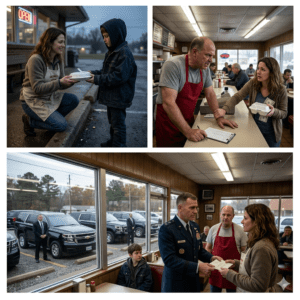
I looked out the front window. Through the swirling fog, a line of sleek, identical vehicles emerged. They weren’t trucks or local sedans. They were massive, midnight-black SUVs with tinted windows and government plates.
One by one, they pulled into our gravel parking lot, their tires crunching loudly. They didn’t park in the designated spots. They formed a tight, defensive semicircle around the entire building, effectively blocking the entrance and exit.
“What the hell is this?” Arthur muttered, stepping out of his office with a stack of invoices in his hand. “Is the IRS finally coming for the guys next door?”
The mechanics stood up from their stools, peering out the window. “Those look like federal plates,” one of them said, his voice dropping to a nervous whisper.
Before anyone could move, the doors of the SUVs opened in perfect unison. Men in dark, tailored suits stepped out, taking up positions at the corners of the building. They weren’t carrying standard holsters; these men looked like they were guarding a moving fortress.
My heart began to hammer against my ribs. I looked toward the side door, my immediate thought flying to Leo. Was he okay? Did he run?
Through the glass of the side door, I saw two of the suited men gently guide Leo away from the concrete barrier. They weren’t hurting him—in fact, one of them handed him a warm, heavy blanket—but they were moving him with absolute authority.
“Clara!” Arthur yelled, his voice cracking with sudden panic. “What did you do? Did you mix up those health inspection forms? Who are these people?”
I couldn’t answer. I could only watch as the front door of the diner swung open, the small brass bell ringing with a sharp, terrified chime.
A Colonel Walked In, Asking for Me
The man who entered didn’t look like the others.
He wasn’t wearing a suit. He wore a crisp, immaculate military dress uniform, the chest adorned with rows of colorful ribbons and medals that caught the harsh fluorescent light of the diner. He was tall, with silver hair cropped close to his skull and eyes that looked like they had stared into the sun and didn’t blink.
The entire diner fell into a dead, breathless silence. The only sound was the rhythmic tapping of his polished leather boots against our linoleum floor.
Arthur immediately stepped forward, his usual bluster completely evaporating. He wiped his sweaty hands on his apron, offering a weak, trembling smile. “Can… can I help you, officer? Sir? We just opened, if you’re looking for a table—”
The military officer didn’t even look at him. His eyes scanned the room, passing over the terrified mechanics, bypassing Arthur entirely, and locking directly onto me.
“I am looking for Clara Vance,” the officer said. His voice wasn’t loud, but it possessed a commanding, resonant weight that seemed to fill every corner of the room.
I swallowed hard, my hands gripping the coffee pot so tightly my knuckles turned white. I stepped out from behind the counter. “I’m Clara,” I said, my voice shaking despite my best efforts to keep it steady.
The officer walked toward me. With every step he took, the tension in the room grew thicker. Arthur took a hasty step back, completely abandoning me to whatever fate was walking my way.
The man stopped exactly two feet in front of me. For a long moment, he simply studied my face. The stern, hardened expression he wore didn’t soften, but something shifted in his gaze—a flicker of profound respect, perhaps even sorrow.
He removed his military cap, tucked it under his arm, and extended his right hand.
“I am Colonel Thomas Vance,” he said. “No relation, though it is an honor to share a name with you.”
I hesitantly reached out and shook his hand. His grip was firm, warm, and steady. “I don’t understand,” I whispered. “What is this about? Is it about Leo?”
The Colonel looked out the window toward the black SUVs where the boy was now sitting safely inside one of the warm vehicles. “Yes,” the Colonel replied softly. “It is entirely about Leo. Or rather, it is about his father.”
“The Boy’s Father Was One of My Men,” He Said. “His Final Letter Was About You.”
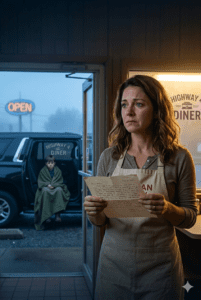
The Colonel signaled to one of his men outside, who immediately stood guard at the diner door, ensuring no one else could enter. Arthur and the mechanics watched from the far corner of the room, utterly paralyzed by the spectacle.
“Clara,” Colonel Vance began, his voice dropping to a tone meant only for me. “The boy’s father was Sergeant First Class Michael Miller. He was one of my men. A medic. He served under my command during three tours of duty.”
A heavy silence settled over us. I felt a lump form in my throat. “Served? Past tense?”
The Colonel nodded, a shadow crossing his face. “Michael was killed in action four weeks ago. He was part of a covert operations team operating under deep cover. Because of the nature of his deployment, his death was kept classified, and his family couldn’t be notified immediately through the standard channels.”
“Oh, no,” I breathed, covering my mouth with my hand. I thought of Leo, sitting out in the cold every morning, waiting for a father who was never coming home. “Leo… does he know?”
“He knows now,” the Colonel said gently. “Michael’s wife passed away two years ago from cancer. When Michael was deployed, Leo was left in the temporary care of his aunt. But the aunt fell into hard times, struggled with addiction, and the money Michael was sending home was… misappropriated.
The boy was neglected. He was starving, Clara.”
Tears pricked the corners of my eyes. “He never said a word. He just sat there. I couldn’t bear to see him look so empty.”
“We know,” Colonel Vance said. A faint, genuine smile finally touched his lips. He reached into his breast pocket and pulled out a folded piece of heavy, lined paper. The edges were slightly singed, and there was a faint smudge of dried mud on the corner.
“Before his final mission, Michael knew the risks were exceptionally high,” the Colonel explained, handing me the letter. “He was allowed to send one final package of letters through a secure courier, to be opened only in the event of his death. Most were for Leo. But there was one note addressed to me, his commanding officer.”
I unfolded the paper with trembling fingers. The handwriting was hurried, written in a bold, sweeping script.
Colonel, If you are reading this, I didn’t make it back. My only regret is leaving my boy, Leo. I know the bureaucracy takes time, and I know my sister-in-law is struggling. I’ve been terrified that Leo is falling through the cracks while I’m away. But a week ago, during my last satellite call with him, he told me something that gave me peace. He told me about a woman named Clara at the Highway 4 Diner.
He said every single morning, she cooks him breakfast. He told me she protects him, looks out for him, and treats him like he matters. In a world this dark, she is his light. Colonel, I ask you not as my commander, but as my brother-in-arms: when you go to retrieve my boy to bring him to his legal guardians, find Clara. Thank her for me. Tell her that a dying soldier went into the dark knowing his son wasn’t completely alone, because of her.
By the time I finished reading, tears were streaming freely down my face. The words blurred together. I looked up at the Colonel, unable to speak.
“Sergeant Miller’s estate is substantial,” Colonel Vance said, his voice ringing with absolute clarity. “Leo is being placed in the custody of his godparents—a wonderful, loving military family who have been waiting to receive him. He will never go hungry again. He will have everything he ever needs.”
The Colonel then turned his head, his sharp eyes locking onto Arthur, who shrunk back against the pastry case.
“I am also aware,” the Colonel continued, loud enough for my boss to hear, “that some individuals in this establishment considered the feeding of a soldier’s son to be a ‘waste of food’ and a ‘liability.’ Rest assured, the Department of Defense remembers its friends, and it certainly remembers those who mistreat the families of our fallen.”
Arthur looked as though he might faint.
Colonel Vance turned back to me, extending his hand once more. “Clara, on behalf of the United States Army, and on behalf of a grateful father, thank you for your service.”
I shook his hand, wiping my tears with my apron. “Can I say goodbye to him?”
“Of course,” the Colonel smiled. “He’s waiting for you.”
I walked out the side door of the diner, leaving the smell of grease and Arthur’s petty rules behind. When I approached the black SUV, the window rolled down. Leo was sitting inside, wrapped in the thick green military blanket, a small chocolate milk box in his hand.
For the first time since I had met him, a massive, brilliant smile lit up his face.
“Hi, Clara,” he said clearly.
“Hi, Leo,” I choked out, leaning through the window to give him a gentle hug. “You’re going somewhere safe now. You’re going to be okay.”
“I know,” Leo said, his eyes shining. “I told my dad about you. I told him you made the best pancakes in the world.”
“You tell everyone that, okay?” I smiled, squeezing his shoulder.
As the convoy of black SUVs slowly pulled out of the gravel lot and disappeared into the morning fog, I stood by the highway, the cold wind blowing against my face. I didn’t feel cold anymore. I felt a profound, deep warmth. I had just been a waitress making minimum wage, but in the grand tapestry of a soldier’s life, a simple plate of pancakes had been the greatest act of bravery that mattered.
If you loved this story, then you may like the other story:
👉 The Echoes of Willow Creek: How an Old Letters Unlocked a Town’s Best-Kept Secret