Building a sand house
It’s not that I often talk about my past. In fact, if you had asked me a few years ago, I would have told you that the past is simply a closed book that is no longer worth reading. But people change. They change because they are forced to, because the wounds they carry on their skin begin to make a sound when you try to cover them with silence. Today I understand that to explain why I find it so hard to believe, why my eyes always search for a way out in every room I enter, I have to tell you how my world collapsed. Not once, but twice.
My life has never been a red carpet road. As a child, I remember watching my mother’s hands grow rough from overwork and my father’s forehead creased from bills that were never paid on time. We lived in a small town, one of those places where everyone knows you, but no one helps you when you need it. When I turned sixteen, I realized that my teenage dreams would have to wait. My family needed bread, light, survival.
Thus began my era of sleepless nights. During the day I was in school, my head buried in my books, trying to be the best student, because I blindly believed that education was the only way out of that suffocating poverty. As soon as night fell, I would put on the apron of a small café near the train station on the outskirts of Lyon, France, where we moved when I was still a child. While my peers planned their weekends or talked about first loves, I would clear tables, put up with drunk customers, and count the tips in the hope that they would be enough to buy my father’s medicine.
I slept three or four hours a night. I remember the constant burning sensation in my eyes, that chronic fatigue that seeps into your core and makes you feel like you’re walking on water. But I didn’t complain. There was a kind of wild pride in me, a stubbornness that told me that no one was going to come and save me. I had to do it myself.
The years passed, and this stubbornness paid off. I managed to graduate from college, find a steady job at a management company in Paris, and, for the first time in many years, breathe freely. I rented a small apartment in the 11th arrondissement. It wasn’t big—a single room where the bed was almost next to the kitchen, and the window looked out onto a dark interior courtyard—but it was mine. It was my castle. Every piece of furniture, every cup of coffee, every pillow had been bought with my own money, with my own sweat, with those long nights when my dinner had been just a slice of bread and butter.
I had created a stable life. There was a nice routine to waking up at seven, walking to the subway, smelling the warm croissants from the neighborhood bakery. I was at peace. Or so I thought, until Julian entered my life.
Julian was everything I wasn’t. He came from a world where things just happened, without having to be fought for. Born and raised in Chicago, to a family that owned an old real estate business, he had the kind of self-confidence that only people who have never known hunger or the fear of eviction have. We met at an international conference in Paris. He was intelligent, had a smile that made you feel instantly confident, and, above all, he took an extraordinary interest in me.
At first I was skeptical. Our lives were very different. But Julian insisted. For months, after he returned to the US, we talked every day. The distance was no obstacle; on the contrary, it seemed to increase our desire to be together. He came to Paris whenever he could. He took me to places that, even though I lived there, I had never seen because I had always been too busy working.
Over the years – because yes, we met and lived a long-distance relationship for almost four years – he became my point of reference. When I had a tough day at work, it was his voice on the phone that calmed me down. When I felt lonely, he would send me flowers or just text messages reminding me that “soon we would be together forever.”
My trust in him wasn’t built overnight. It took years for me to lay down my arms, to accept that I could fall in love without fear of getting hurt. Julian became my refuge. And when, after four years of waiting, he got down on one knee in a small restaurant in Montmartre and asked me to be his wife, I said “Yes” with all the strength of my soul.
The plan was clear: we would apply for a fiancée visa (K-1 visa). I would leave Paris and move to Chicago to start our new life. The process was long, bureaucratic, and exhausting. Months of paperwork, interviews, proof of our relationship, fees paid. But every time I got tired, Julian would tell me: “Think about our house, think about the garden we will have, think about never being separated at the airport again.”
And I believed it. I believed it with the pure naivety of someone who thinks that after the storm, it’s finally time for some sunshine.
When the visa was finally approved, the last few months in Paris were like a sweet nap. I had to pack my bags, but more than that, I had to close a chapter. And here began my big mistake. To show my full commitment, to show that I was entering that marriage with my whole being, I decided not to hold any bridges behind me.
Now that I think about it, I feel like screaming at the girl I was back then. But at the time, it seemed like the right thing to do.
I called the landlord and told him I was leaving the apartment. I remember the day I started selling my furniture. Every table, every chair I had bought with so much effort was leaving my house for a few euros. Strangers came and went, taking part in my life. As the room emptied, a strange feeling of emptiness began to take hold of me, but I suppressed it by thinking about Chicago.
I resigned from my job. My boss looked at me with pity: “Are you sure? You have a great career here.” I smiled and told him that love was worth more. Oh, how stupid I was…
I closed my bank accounts in France, converted any savings into dollars and transferred them to an account that Julian and I would use together. I sold everything except three large suitcases containing my clothes, some old family photos, and my favorite books.
On my last day in Paris, I sat on the empty floor of my beloved apartment. The echoes of my footsteps sounded like strangers. I no longer had a job. I no longer had a home. I no longer had a social status in the city I had so laboriously conquered. I was stripped of everything that identified me, but I felt light. I believed I was flying toward happiness.
I didn’t know that I was actually falling from an amphitheater with no safety net below.
The first refraction of light
The flight across the Atlantic lasted almost eight hours, but for me it felt like a suspended infinity. As the plane broke through the clouds towards Chicago Airport, I looked out the small window at the circumstances I had left behind. Everything I had been – the esteemed manager, the girl who had conquered Paris with determination, the friend who had left behind long Friday dinners at Café de Flore – was now packed into three large suitcases in the cabin.
In my pocket I carried my passport with the K-1 visa stuck to it. It was a bright sheet of paper bearing the seal of our vows. According to the rules, we had exactly 90 days to officially get married, otherwise I would have to leave the country. But time did not frighten me. Four years of waiting had prepared us for this.
When I stepped out into the lobby, I thought the Chicago air would taste like freedom. Julian was waiting for me. He had a bouquet of white lilies in his hands and that warm, boyish smile of his that always made me forget any doubts. When he hugged me, I smelled his familiar scent – a mix of expensive cologne and light tobacco. For a few seconds, all my fears were erased. There he was. My man. My shelter.
His house on Beacon Hill was exactly as he had described it: an old red brick building with large windows overlooking the cobblestone streets. Everything inside shone with quiet luxury. There were expensive paintings on the walls, soft Persian rugs, and a quietness that almost made you want to tiptoe around.
“Welcome home, honey,” he said, dropping my suitcases into the hallway. The word “home” sounded nice, but something inside me refused to accept that environment as mine. It was too perfect, too untouched by my labor.
The first few weeks passed in a kind of controlled haze of happiness. We walked along the river, made plans for the wedding—which he had planned to be a small, elegant ceremony, with only family and close friends—and I began to adjust to the new pace of life. But slowly, like those invisible changes in the weather before a storm, something began to change in Julian’s demeanor.
It was the fourth week when I noticed the first cracks.
It all started with conversations about finances and wedding paperwork. One evening, as we sat in the kitchen drinking wine, I brought up the subject of registering the marriage at the municipality. There was a little over a month left before the legal deadline.
“We need to set a date at the city hall, Julian,” I said calmly. “The paperwork takes time and I don’t want us to be under pressure in the last few days.”
He didn’t answer right away. He turned the wine glass over in his hands, staring at the red liquid as if searching for an answer within. His eyes, which had once looked at me with pure adoration, now had a kind of distant coldness.
“Why are you in such a hurry?” he asked, in a voice I had never heard before. It wasn’t my fiancé’s voice, it was the voice of a stranger making a business transaction.
“I’m not in a hurry, I’m just following the visa rules,” I replied, trying to keep my tone even, though a pang of fear pricked my chest. “You know we only have 90 days.”
“Yes, I know,” he said, setting his glass down on the table with a rather loud thud. “But Mom and Dad think we’re rushing things. They think we should get to know each other better in real-life situations before we sign a legal contract that could affect our entire family.”
I was speechless. Let’s get to know each other better? After four years?
“Julian, I sold everything to come here,” I said, my voice starting to shake, despite my efforts to sound strong. “I don’t have a house in Paris anymore. I don’t have a job anymore. I even transferred my savings here. What do you mean we’re in a hurry?”
He rose from the table, spread his hands in surrender, and turned his back. “You always make everything into a personal drama. My parents are just being pragmatic. They have an asset to protect, a name. You come from a completely different background, you can’t understand these things.”
Those words cut like cold knives. “A completely different background.” He had often mentioned my origins, my family, or the fact that I had worked in cafes to survive, as some kind of shortcoming or danger to him. During the years in Paris, he had told me that he admired my strength, that I was a “fighter.” Now, that strength was becoming a threat to his family’s fortune.
From that night on, the house on Beacon Hill became a silent prison. Julian began to stay at work more. When he returned, he was tired, cold, and avoided any physical contact or conversation about the future. I spent my days alone in those large rooms, watching the clock tick down. The feeling of helplessness was suffocating. In America, without a Social Security number (SSN) and without a work permit, I was a mere shadow. I couldn’t work, I couldn’t open my own account, I couldn’t do anything but wait for him to decide my fate.
I started having sleepless nights again. But this time it wasn’t work fatigue, it was pure anxiety that makes you hear every beat of your heart in the dark.
In the seventh week, his parents invited us to dinner at their Cape Cod mansion. I prepared myself very carefully. I wore a simple, elegant dress that I had bought in Paris for special occasions. All the way in the car, I tried to hold Julian’s hand, but he held the wheel with both hands, looking straight ahead as if he were going to a trial.
The dinner was a nightmare disguised as a refined aristocratic manner. His mother, Eleanor, a woman with perfectly coiffed hair and a gaze that seemed to scan every cell, took the opportunity to mention the “cultural differences” and “difficulties of adjustment.”
“My dear,” she said to me, as the roast beef was served, “Juliani has a great responsibility to our family business. We understand that you have had a difficult life in Europe, that you have had to work hard for the basics… but for this very reason, we believe that marriages should be built on equal footing. When values and family backgrounds are so different, success is difficult.”
I looked at Julian, waiting for him to say something. My protector, the man who had promised to be by my side against the world, simply lowered his head and continued eating. He didn’t say a word. In that moment, I realized that I hadn’t just lost his support—I had also lost the Julian I knew. This person in front of me was simply an extension of his parents’ wishes, a spineless man who was afraid to grow up.
When we got home that night, the silence between us was so heavy it could be touched. I couldn’t hold it in anymore.
“So, is that all?” I asked, as we entered the hallway. “You’re letting me be treated like a beggar who came here for your money? You know who I am, Julian! You know how hard I’ve worked!”
He turned to me, and for the first time I saw a kind of wild irritation in his eyes. “My parents are right! You’re too tough. You have that mentality of someone who always has to fight to survive, and it wears me out. I need a woman who brings peace, not someone who carries the weight of the whole world on her shoulders and expects me to save her.”
“I didn’t ask you to save me!” I screamed, tears finally bursting out uncontrollably. “I was saved myself in Paris! You came and asked me to leave everything! You told me we were a team!”
“Maybe I was wrong,” he said, in a voice so calm it froze my blood. “Maybe I just fell in love with the idea of a Parisian romance, but the reality is different. I’m not ready for this.”
He turned, entered the guest room, and closed the door behind him. I was left alone in the hallway, surrounded by expensive paintings and Persian rugs, realizing that my sandcastle had just been hit by the first big wave.
The long night of the soul
I accepted the change of scene without even noticing it; after all, when the world turns upside down, it doesn’t matter if you’re falling from the heights of Chicago’s skyscrapers. The cold wind coming off the lake began to be felt in early November, rattling the windows of the large apartment where we lived. That wind became the background music of my lonely days.
After that night when Julian closed the guest room door, we stopped being a couple. We lived under the same roof like two strangers sharing an unspoken truce. I would wake up early, make coffee, and sit in the kitchen watching the fog covering the lake, while he would only come out of his room when I had gone to the next room. There was something deeply humiliating about the way he avoided me, as if I were an old garment he had forgotten to throw in the trash.
My visa was about to expire. There were exactly two weeks left until the end of the 90 days.
On November 14, Julian came home earlier than usual. He didn’t have his work bag, nor his heavy coat. He had only a white envelope in his hand. He sat down across from me at the walnut dining table—the same table where we used to plan our trips around America.
“We need to talk,” he said. His voice held neither anger nor hatred. It was simply empty. And that emptiness was the scariest thing I had ever felt.
“I have cancelled the visa petition,” he continued, looking me in the eye. “I spoke to the family lawyer this morning. The process has officially been discontinued.”
His words seemed to hang in the air for a few seconds before my brain translated them. I felt a kind of physical numbness, as if the blood had stopped circulating through my limbs.
“What does that mean, Julian?” I asked, even though I knew the answer very well.
“It means there will be no wedding. You have to go back to Europe before you become illegal here. I… I can’t do this. I’m not ready for the weight of this relationship. My parents are right, we just want different things out of life. You want security at all costs, you want to build a defense against your past, and I feel suffocated by this pressure.”
I stood up, but my knees were shaking so much that I had to hold on to the chair. “Pressure? I gave up my life for you! I sold my house, my job, I converted every penny I had and gave it to you to put in the joint account for our house! How can you tell me I’m pressuring you?!”
“Your money has been returned to the account you gave me last week,” he said coldly, pushing the white envelope towards me. “It’s all there. Plus an extra amount for your return plane ticket and… to help you reorganize in France.”
An extra sum. He was paying me to leave. He was giving me a severance package as if I were a worker laid off early. At that moment, something inside me broke completely. It wasn’t just my heart; it was my dignity, that backbone that had kept me going through the long nights of work in Lyon and Paris. He was throwing me away like a failed investment.
“Keep your extra money, Julian,” I said, and my voice came out so low and sharp that he finally looked up and looked at me. “I’m not a project you close when you get tired. You’re a coward. And the thing that hurts me the most is not that I’m not marrying you, but that I believed a man like you had a soul.”
I didn’t wait for him to answer. I went into the room, closed two of my three suitcases – the ones I had never fully opened – and began packing the few things I had taken out. I didn’t cry. The tears wouldn’t come. There was just a terrible burning sensation in my throat and a heaviness in my chest that prevented me from taking a deep breath.
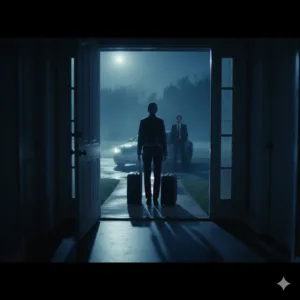
The next morning, Chicago woke to a cold drizzle. Julian had left early, leaving only the apartment keys on the kitchen counter. I grabbed my bags and headed out into the street. When the building door closed behind me with a muffled metallic clank, I realized I was officially homeless. I had nowhere to go. My visa was expiring in a few days, I wasn’t eligible to rent an apartment here, and in France… in France, there was no one waiting for me. My old house had a new owner, my job had a new manager. I was a ghost between two continents.
I sat in a small café near the metro station, my three large suitcases lined up at the table. Customers coming in and out looked at me with a mixture of curiosity and annoyance; I was just another person lost in a big city who didn’t have time to stop and ask why I was crying.
In the height of despair, I called one of my old college friends, Anna, who lived in the suburbs of Paris. It was a difficult decision, because my pride told me not to ask for help, not to admit to anyone that I had failed so badly.
“Ana…” my voice broke as she answered. “There won’t be a wedding. He canceled everything. I… I have nowhere to go.”
Ana’s response was not what I expected. Instead of the warmth and embrace I so desperately needed to feel, even over the phone, I heard a heavy sigh and a tone full of judgment.
“Oh, but how can anyone blindly trust like that?” she said, her voice chilling. “You gave him everything without any guarantees. You knew who he was, what family he came from. Now you’re asking us for help because you didn’t think about the consequences. I have my own life here, my apartment is small, I don’t have the space to keep you for weeks until you find a job.”
I closed my eyes. Each of her words was like a second blow to a wound that was still bleeding. I felt that the world was not only punishing me for my misfortune, but was judging me for why I had dared to hope, why I had dared to believe that I deserved something better than my old life of sacrifice. In my most painful moment, when I simply needed a hand to hold me from falling into the abyss, I found only fingers pointing at my guilt.
I hung up the phone without saying goodbye. I sat there, in that foreign cafe in Chicago, watching the raindrops circling the glass, and for the first time in my life, I felt like I no longer had the strength to get up. My sandcastle had been completely wiped out, and I was drowning under its rubble.
Rebuilding on ruins
The return flight felt like a prison sentence. When the wheels of the plane left the runway at Chicago’s O’Hare Airport, I didn’t look back. I left behind the cold skyscrapers, the lake that looked like a broken mirror, and that empty room on the *Gold Coast* where I had buried four years of hope.
When I arrived in Paris, the city welcomed me with a gray sky and a fine, annoying rain, the kind that gets into your bones without you realizing it. It was the end of November. While people were hurrying with umbrellas in their hands, returning to their warm homes, I stood in the middle of the *Gare du Nord* train station with my three large suitcases. The feeling of being a stranger in the city where I had lived for years was more painful than anything else. I no longer had an address. I no longer had a French identity card valid for immediate employment, because I had closed everything in a hurry.
Instead of begging for shelter from Ana or other friends who would surely look at me with that mixture of pity and smugness (“We told you so…”), I decided to do what I had always done: rely on myself.
I rented a small room in a cheap hotel on the outskirts of Saint-Denis. It was a cramped room, where the smell of dampness and stale tobacco was impossible to get rid of. The space was so small that two of my suitcases had to stay locked, lined up next to the door, reminding me every second that my life was still packed, temporary, uncertain.
The first nights in that hotel were the darkest of my life. I would wake up in the middle of the night forgetting where I was. I would reach out into the darkness, searching for Julian, or perhaps searching for that feeling of security I had had in my old apartment in Paris. When my fingers touched the cold, hard wall of the cheap hotel, reality hit me like a cold shower. I was back at ground zero. Or worse, I was at zero, because this time I carried with me the weight of a spiritual break that wouldn’t let me breathe.
During the day, I would put on my one remaining coat and walk the streets of Paris, handing out resumes to every office, every management agency, even those little cafes where I had worked as a student. But the business world is cruel. When they saw a few months of blank space on my resume, or when they realized that I had resigned from a good position to go abroad, the HR people looked at me with suspicion. To them, I was a risk – someone who could leave again at any moment on a personal impulse.
“You’re overqualified for this secretarial position,” a thick-bespectacled man at a small insurance company told me one day. “And frankly, I don’t understand why you came back from America if things were as good as you say in your cover letter.”
I sat across from him and bit my tongue to keep from crying. How could I explain to this man that my life wasn’t a list of bullet points on an A4 sheet? How could I tell him that I came back because the man I loved decided that I wasn’t worth the effort of confronting his parents?
My savings were melting away at a frightening rate. Every day in that hotel cost money, every meal eaten in a hurry in a bakery reduced my chances of surviving the following month. There were days when I would pass by my old apartment in the eleventh arrondissement. I would look at the third-floor window, where different curtains from mine now hung. I would look at the light burning inside and think about how, in a few months, a person could become a complete stranger in his own life.
In the third week of December, when my soul was completely surrendering under the weight of despair, fate finally decided to turn its head towards me. A former client of my old company, an elderly man named Mr. Girard, called me on the phone. He had heard from the old offices that I had returned to Paris and needed someone to manage a new restructuring project for his small logistics business.
“It’s not a big position like the one you had before,” he told me in that warm, fatherly voice over the phone. “But I need someone who can work under pressure, someone who’s not afraid of hard work. And I remember how dedicated you were.”
When I hung up the phone, I sat on the floor of the hotel room and for the first time in months, I cried. But this time they weren’t tears of despair. They were tears of relief. It was like someone was finally seeing me for who I really was: a hardworking, ladylike woman who was worth something despite the fact that her personal life had fallen apart.
Work became my therapy. I worked ten, twelve hours a day. The mental load helped me keep away the shadows of Chicago and Julian’s voice telling me I was “too tough.” With my first paycheck, I was able to move out of the hotel and rent a small studio in the Belleville neighborhood. It was even smaller than my first apartment—the window overlooked a noisy alley and the ceilings were low—but when I put my suitcases there and opened them for the first time in four months, I felt like I was setting my first anchor on solid ground.
I started buying my things again, one by one. A pot, two plates, a simple bed that I assembled myself over a long weekend. Every screw I tightened was like a promise I made to myself: *I’m getting back up. It doesn’t matter who left me, it doesn’t matter who made me feel like I wasn’t enough. I am enough for myself.*
But as my outer life slowly stabilized, the inner wounds were turning into something else. They were turning into a thick, cold shield of ice. Every time someone at work tried to approach me, every time a colleague invited me for coffee after work, I would find an excuse to leave. My trust in people had gone with that return flight. Every time I saw a warm smile, my brain automatically started searching for the ulterior motive, the lie behind it, the moment when that smile would turn to a suffocating coldness.
I had managed to rebuild the walls of my castle, but this time I hadn’t made it out of sand. I had made it out of cold, impenetrable stone, locking myself inside it, safe from the world, but terribly lonely.
Wounds and open horizons
It’s been a long time since that cold winter when I returned to Paris with three suitcases and a shattered soul. Today, my studio in Belleville has more light. On the windowsill I have placed some flower pots that bloom every spring, and in the corner near the library there is a comfortable armchair where I spend my evenings reading. My life is mine again. Built with solid bricks, paid for with the pure currency of my work and protected by a peace that I have earned with much effort.
But rebuilding a life is not the same as healing a soul.
For a long time, I thought my success at work and my financial independence were proof that everything was over. I told myself that I was strong because I no longer needed anyone. Every time I went out into the street and saw couples walking hand in hand along the Seine, I felt a mixture of pity and cold superiority. *“How naive,”* I thought. *“They don’t know how quickly what they think they have can be broken.”*
But it wasn’t strength. It was just numbness. It was fear disguised as pride.
The hardest part of what happened to me in Chicago wasn’t losing Julian. As the months passed, I realized that the man I had loved no longer existed—or perhaps had never existed outside of my imagination and the distance that softened every flaw. The painful truth was that I wasn’t suffering from his loss. I was suffering because I had lost my ability to trust.
When someone you loved with all your being, someone you sacrificed everything you’ve built for, decides to throw you away and tell you that your worth is determined by your background or the hardships you’ve gone through, something inside you changes radically. You start to doubt yourself. Every night, before I fell asleep, the question that echoed in my head was the same: *”Was it my fault? Was I really too tough? Was it me who wasn’t enough?”*
It took me years to give the right answer to this question. And the answer came not from the words of others, but from looking in the mirror on a simple Tuesday morning. I saw the small wrinkles around my eyes, a sign of long nights of work, but also of the laughter that I had begun to bring back into my daily life. I saw my hands that had carried heavy weights, but that had never refused to beg.
It wasn’t my fault. I hadn’t failed because I had loved or because I had believed. I had dared to do what small people and cowards never do: risk everything for a dream. Julian and his family might have all the bank accounts in the world and all the skyscrapers in Chicago, but they were poor in spirit. They lived locked in their golden cage, afraid of everything that was real, raw, and hard-earned. My strength, that “roughness” that he found tiring, was actually the most beautiful thing about me. It was proof that I was alive.
Today, I still have scars on my soul. I have fears that sometimes wake me up in the middle of the night and a complicated story that I can’t explain in two words during a chance meeting. But, despite everything, I still choose to trust people.
I don’t care if someone is rich or poor, I don’t care what title they have on their business card or what neighborhood they come from. What I seek, what truly matters to me right now, is something much rarer and more precious: pure sincerity, mutual respect, empathy to understand the pain of another, and the ability to see beyond the circumstances of the moment.
If one day you choose to know me, whether our paths cross in this great city or somewhere else, I have only one request for you. Do not judge me for the battles I have had to go through. Do not see me as a victim of a sad tale of betrayal, but neither as an invincible heroine made of stone.
Judge me for who I am today: a woman who has fallen many times, who has seen her world turn to dust and ashes on two different continents, but who has always, in one way or another, found the strength to get up again, to dust herself off, and to continue on the path forward.
Because in the end, the greatest break wasn’t the loss of that connection. It was the loss of trust. But the most beautiful thing about life is that what is lost in the darkness can be found again in the light. And I, finally, am finding my light.

If you liked this story, then also read: